
Cambria Tech Ltd

Support Service

Ready to transform your business or charity? Let's start the conversation. Contact us today!

Quick contact info

Our Solutions pride on world class customer service.


    Category Archives: Uncategorized

    Categories Uncategorized

    Time Well Spent: Our Most Unusual Case Yet

    At Cambria Tech Ltd., our day-to-day work usually centres around helping organisations refine their business processes and navigate technology deployments. But every so often, a request comes along that sits outside our usual remit—yet sparks our curiosity enough that we simply can’t resist taking a closer look. We love a good challenge, especially when it lets us put our engineering instincts to work in unexpected ways.

    That’s exactly what happened when we were introduced to a local group of volunteers responsible for a turret clock in a church tower. Their Victorian clock had begun running fast, and although it was under contract with a respected specialist firm, the volunteers weren’t in a position to cover the call-out costs for what might have been a straightforward fix. They asked if we could at least take a look.

    We were very open from the start: we’re not clockmakers. But a piece of Victorian engineering paired with a modern control system? That was enough to pique our interest.

    After climbing the tower and examining the setup, we carried out our own research into turret clocks—an unexpectedly fascinating rabbit hole—alongside studying manuals for the modern device installed in the clock chamber. This device uses a movable electromagnet to momentarily pause the pendulum and correct the clock’s timing each hour. A beautifully clever solution for older clocks.

    It didn’t take long for the picture to come together. The clock itself was running exactly as it should—but it had been intentionally set a little fast so that the control system could make its hourly correction. Unfortunately, the small plastic plate on the pendulum (the piece the magnet attaches to) had broken. Without it, the mechanism had nudged the pendulum slightly out of alignment, causing the problem the volunteers had spotted.

    When we began investigating replacement parts, we made an amusing discovery: the piece wasn’t some obscure, specialised component. It was identical to a widely available automatic fire-door retainer costing about £7.

    So we sourced several replacements, returned to the site, fitted a new plate, and left spare parts—and even a small toolkit—inside the clock chamber so the volunteers wouldn’t be caught out again between maintenance visits. After realigning the pendulum and checking the magnet’s operation, the clock settled back into proper timekeeping, and it’s been running happily ever since.

    For the volunteers, the solution cost significantly less than a standard call-out. For us, it was a rewarding opportunity to apply engineering thinking from one field to a completely different one.

    This little adventure up a church tower is a great reminder of what we value at Cambria Tech: adaptability, curiosity, and a willingness to use our broad technical experience wherever it can make a difference—even in the most unexpected places.

    Categories Uncategorized

    Fixing a Jammed Printer Led to Solving Building Problems

    Introduction

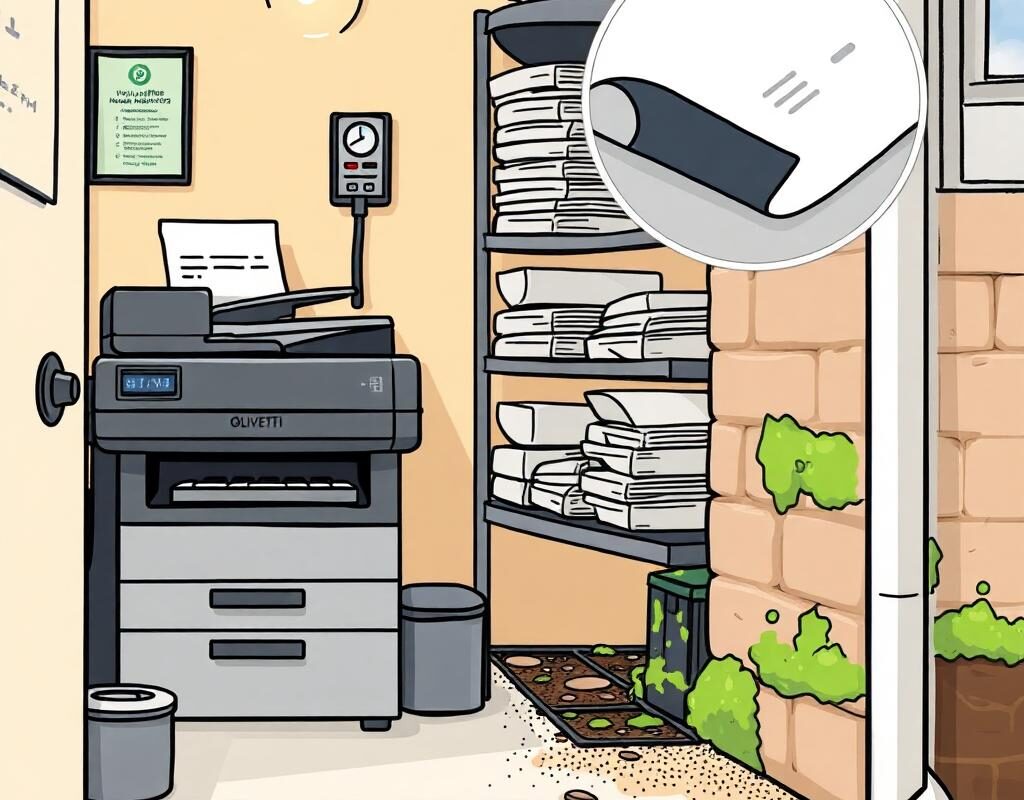
    One unexpected phone call from a local charity turned into a reminder of why systems thinking matters. The charity’s main Olivetti d‑MF304 printer—used for newsletters, booklets and posters in their church hall—was constantly jamming. Engineers had been called repeatedly under a supply-and-maintenance contract, parts had been replaced, and the supplier even advised switching to far more expensive paper. Volunteers were frustrated and reluctant to help with printing. Cambria Tech were asked to take a look.

    Initial assessment – restrictions and first impressions

    Because the printer was covered by a maintenance contract, we avoided any intrusive internal investigations and only opened panels that didn’t require screwdrivers. The printer sat in a small, unheated room where the machine’s own warmth kept conditions roughly acceptable. Nearby paper was stored on racking in an adjacent storeroom. Both rooms were clean, with laminate floors and plasterboard partitions; one wall in each room was a thick stone exterior wall.

    A quick test print confirmed the problem: after a few pages the printer jammed. We examined the papers that had been through the printer under a magnifier and noticed a very faint strip of black toner along one edge of the paper. The strip was strongest on the first page and faded on later pages. When we opened accessible panels the printer’s innards showed some loose toner and a little moisture on rollers when wiped — small, but enough to make toner cling to the cloth.

    Measuring humidity and inspecting the building

    We used a hygrometer from our toolbox and found high humidity in both rooms. That prompted a wider inspection of the building exterior. Around the back and side of the church hall we found failed mortar pointing, vegetation-covered and missing gutters, thick moss on the ground, and trees growing close to the wall. Beneath the moss we found a gravel bed that likely concealed an old French drain. Our conclusion: persistent high humidity in the printer and paper rooms was being fed by external water ingress — likely from blocked/failed drains, compromised gutters and damaged pointing — causing the toner and rollers to behave badly and leading to frequent jams.

    Recommendations and prioritisation

    The charity was on a tight budget, so we presented a prioritised, practical action plan:

    • Immediate: clear and repair gutters (to stop ongoing rainwater ingress).
    • Immediate: install dehumidifiers in the print and paper storage rooms.
    • Short-term: investigate the gravel bed and repair or replace the French drain where necessary.
    • Medium-term: repoint exterior stonework where mortar had failed.

    Implementation and outcomes

    The trustees followed the two easiest steps right away: clearing/repairing gutters and installing dehumidifiers. The dehumidifiers initially filled quickly — confirming a large internal moisture load. Following a request from the trustees Cambria Tech agreed to project-manage the remaining remedial work, arranging drainage contractors, moss and vegetation clearance, and lining up craftsmen for repointing as needed. We also assisted with fundraising and small-grant applications to help fund the work.

    Contractors discovered the gravel trench did run around the building, but only the front contained pipework; other sections were effectively gravel filled trenches. The drainage work was completed before winter. Over the following weeks the dehumidifiers required far less emptying; within months they were no longer needing daily attention, and printing returned to normal. Volunteers resumed helping with print jobs, paper waste dropped significantly and less expensive paper was working in the printer and the charity’s operating costs fell back to normal.

    Why this matters – lessons for organisations

    • Symptoms aren’t always what they seem: a recurring hardware fault can have environmental or building-related causes.
    • Take a systems approach: printers, paper storage, building fabric and drainage can interact to create repeating problems.
    • Prioritise low-cost, high-impact fixes first (gutters, dehumidification) while planning for more significant repairs.
    • Practical onsite measurements (humidity, visual inspection) can quickly narrow down root causes.
    • Project management and access to trusted trades can be critical for small organisations lacking in-house resources.

    Conclusion

    What started as a printer fault became a property-maintenance project that solved the root cause of the problem and delivered lasting value for a cash-strapped charity. At Cambria Tech we combine IT and operational know-how with practical site-based investigation and project coordination — so we can fix the immediate issue and address the underlying causes. If recurring equipment faults are disrupting your organisation, it might be time to look beyond the device.

    If your organisation is struggling with recurring IT hardware issues that might be caused by environmental or property factors, contact Cambria Tech Ltd. We investigate, prioritise pragmatic fixes, and manage any follow-on work to get systems reliably back in service.

    Categories Uncategorized

    How We Helped a Charity Cut Utility Costs by 58%

    A few years ago, our team had the opportunity to support a growing charity that had recently expanded into a larger organisation made up of several local branches. As the charity grew, so did the complexity of its financial management — and the trustees recognised the need for a more structured and transparent system.

    That’s where we stepped in.

    Implementing MyFundAccounting for Better Financial Oversight

    We began by implementing MyFundAccounting, a specialist accounting system designed for charities and non-profit organisations. This helped the trustees manage multiple branches within one central platform, improving visibility, consistency, and compliance across the charity’s finances.

    As part of the project, our team also undertook the initial data entry to ensure clean and accurate records from the outset. This gave the charity a strong foundation for financial reporting and decision-making.

    Uncovering an Overspending Issue

    During our review of the Income and Expenditure report, one area immediately stood out — the charity’s utility costs were unusually high compared to the size of its branch buildings. Recognising that something wasn’t right, we investigated further.

    It turned out that one branch had a very concerned treasurer who had avoided switching energy suppliers for several years, fearing that changes might result in higher bills. They had also stopped submitting regular meter readings, which led to inflated estimated charges.

    To make matters worse, the charity was being billed the full rate of VAT and the Climate Change Levy (CCL) — charges that charities are often eligible to reduce or reclaim.

    Taking Action on Behalf of the Trustees

    With the charity trustees’ approval, we liaised directly with the utility providers to correct the situation. Our actions included:

    • Submitting accurate meter readings
    • Applying for the correct VAT and CCL reliefs
    • Reviewing historical billing for overcharges
    • Negotiating appropriate supplier contracts

    The outcome was exceptional:

    • 💷 £14,500 refunded from the utility company
    • ⚡ 58% reduction in ongoing utility costs
    • ✅ All branches now on the correct VAT and CCL rates

    Delivering Real Value to the Charity Sector

    This project remains one of our proudest examples of how proactive charity financial management can deliver tangible benefits. Beyond improving efficiency, the savings allowed the charity to reinvest funds directly into its community work.

    At Cambria Tech, we continue to help charities and not-for-profit organisations gain greater control over their finances through expert accounting system implementation, data management, and financial consultancy. Whether you need support with MyFundAccounting, compliance, or cost analysis, we’re here to help you make every pound go further.